
Arkansas Traffic Ticket Records
Arkansas traffic ticket records are public documents created when a law enforcement officer issues a citation for a traffic violation anywhere in the state. Each citation is filed with the District Court in the county or city where the stop occurred. You can search Arkansas traffic ticket records online through the state's CourtConnect portal, look up a specific citation through the e-Traffic payment system, or contact the local court clerk directly. Whether you need to pay a fine, contest a ticket, check a case status, or get a copy of a citation record, the Arkansas court system gives you several ways to find what you need.
Arkansas Traffic Court Records at a Glance
How Traffic Ticket Records Work in Arkansas
Traffic citations in Arkansas are processed by District Courts. These are limited-jurisdiction courts that handle traffic violations, misdemeanors, ordinance violations, and small claims. Every county in the state has at least one District Court. Larger counties may have more than one, each serving different cities or areas within the county. When a citation is issued, it goes to the District Court listed on the ticket. That court manages the case until it is resolved through payment, a plea, or a court hearing.
Under Arkansas Constitutional Amendment 80, which took effect July 1, 2001, the state unified its court structure. That change brought all courts under a single system. Circuit Courts became general-jurisdiction trial courts handling criminal, civil, probate, domestic relations, and juvenile matters. District Courts stayed on as limited-jurisdiction courts and are the primary courts for traffic violations. If a traffic offense is serious enough to be charged as a felony, the case moves to Circuit Court. But most traffic tickets are resolved entirely at the District Court level.
As of January 1, 2025, Arkansas has 41 District Court judicial districts and 70 full-time district court judges. The Arkansas District Courts page on the official judiciary website lists every active court by county and provides contact information for each location.
Arkansas law enforcement officers use several systems to issue citations. The eCite system, first permitted by Arkansas Act 908 of 2011 and defined under Arkansas Code Ann. § 16-10-202, allows officers to issue electronic citations in the field. That data moves directly into the Contexte case management system used by the courts. Hot Spring County District Court was the first court to process an electronic citation from the Arkansas State Police, which happened on December 19, 2012. The Administrative Office of the Courts runs a nightly process to retrieve new electronic citations and validate them before clerks review and accept the filings.
Search Arkansas Traffic Ticket Records Online
The main tool for searching traffic ticket records in Arkansas is Search ARCourts, also known as CourtConnect. The Arkansas Administrative Office of the Courts (AOC) maintains this official public portal for courts using the Contexte Case Management System. You can search by the name of a person in the case or by the case number. Results include the parties involved, the judge assigned, filings in the case, charges, dispositions, scheduled hearings, and judgments. The system is free to use and open to the public. No account is required.
Not every county has full records online. Only partial court records from Bradley, Desha, Lafayette, and Perry counties are currently on the CourtConnect platform. For most other counties, cases filed after August 1, 2018 are available online. Older records need to be requested in person. Keep in mind there is always a delay between when something is filed or decided and when it appears in the portal. That delay can be at least 24 hours, sometimes longer.
For questions about Search ARCourts, the AOC can be reached at (501) 410-1900 option 1 or toll-free at (866) 823-5778.
The Arkansas Judiciary website links to CourtConnect, the e-Traffic payment system, eFiling tools for attorneys, and general information about all court levels from District Court through the Arkansas Supreme Court.
The Arkansas Search ARCourts portal is the official statewide case search tool, covering traffic ticket records in most of the state's 75 counties.
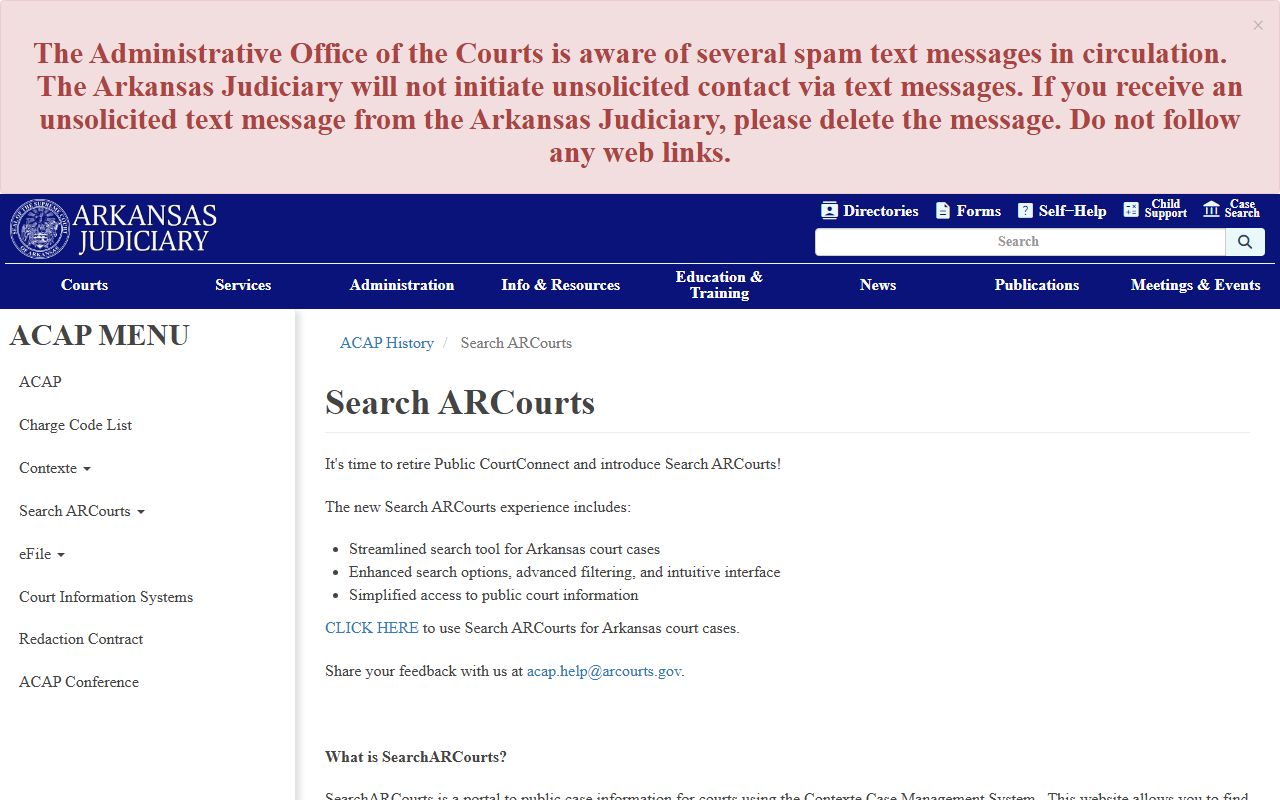
The portal lets you search by name or case number and returns case details including charges, dispositions, and future hearing dates for traffic court cases across Arkansas.
Through the Arkansas Court Case Search system, you can pull up traffic ticket records by entering a party name or case number for participating courts.
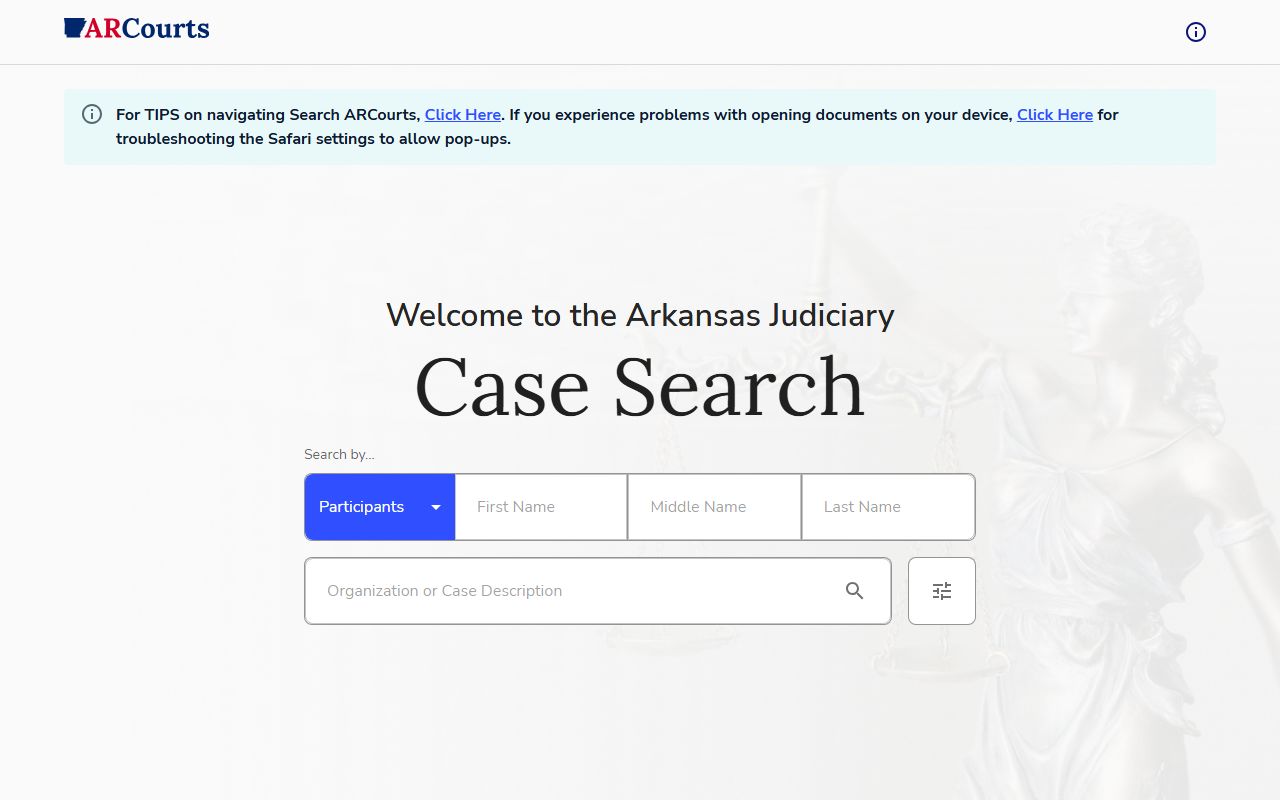
The search tool connects to District Court records statewide and is most complete for traffic citations filed after August 2018 in counties that use the Contexte system.
Paying an Arkansas Traffic Ticket
Arkansas offers online payment for traffic citations through the state's e-Traffic system. Go to Arkansas Online Court Payment to pay a ticket. You will need to enter your first and last name plus either your citation number alone or your driver's license or state ID number along with your date of birth. The system accepts Visa, Discover, and MasterCard. A service charge is added to online payments.
Be aware that paying online is treated as a full admission of guilt. When you submit payment, you waive your right to appear in court and contest the ticket. The payment acts as a plea of guilty or no contest. That can affect your driving record and insurance rates. If the violation is serious, or if you believe the ticket was issued in error, it may be worth speaking with an attorney before paying.
The Arkansas e-Traffic Citation Payment Portal lets you search for a specific citation and pay the associated fine online.
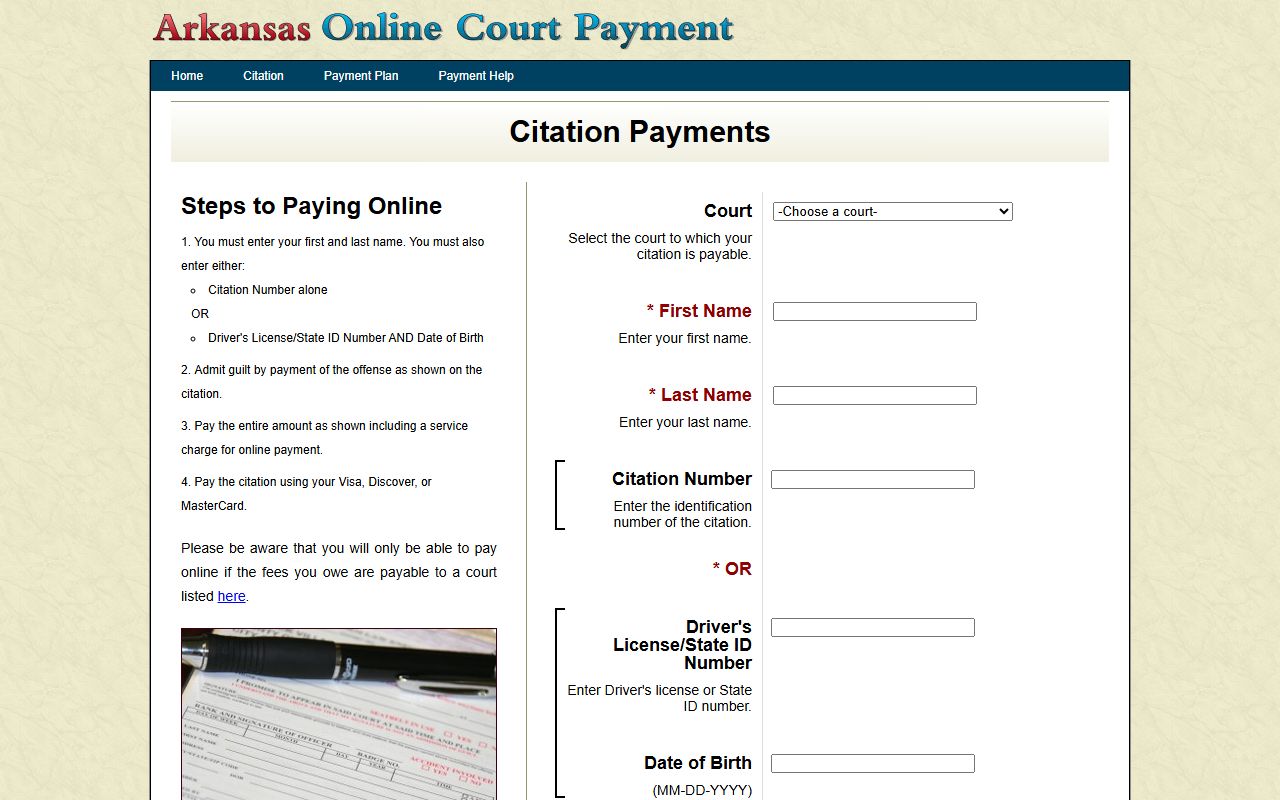
The portal is available for courts that participate in the e-Traffic system. If your court is not listed, contact the court clerk to pay by phone, mail, or in person.
Through the Arkansas Online Court Payment system, drivers can also make payments on court-authorized payment plans without visiting the courthouse.
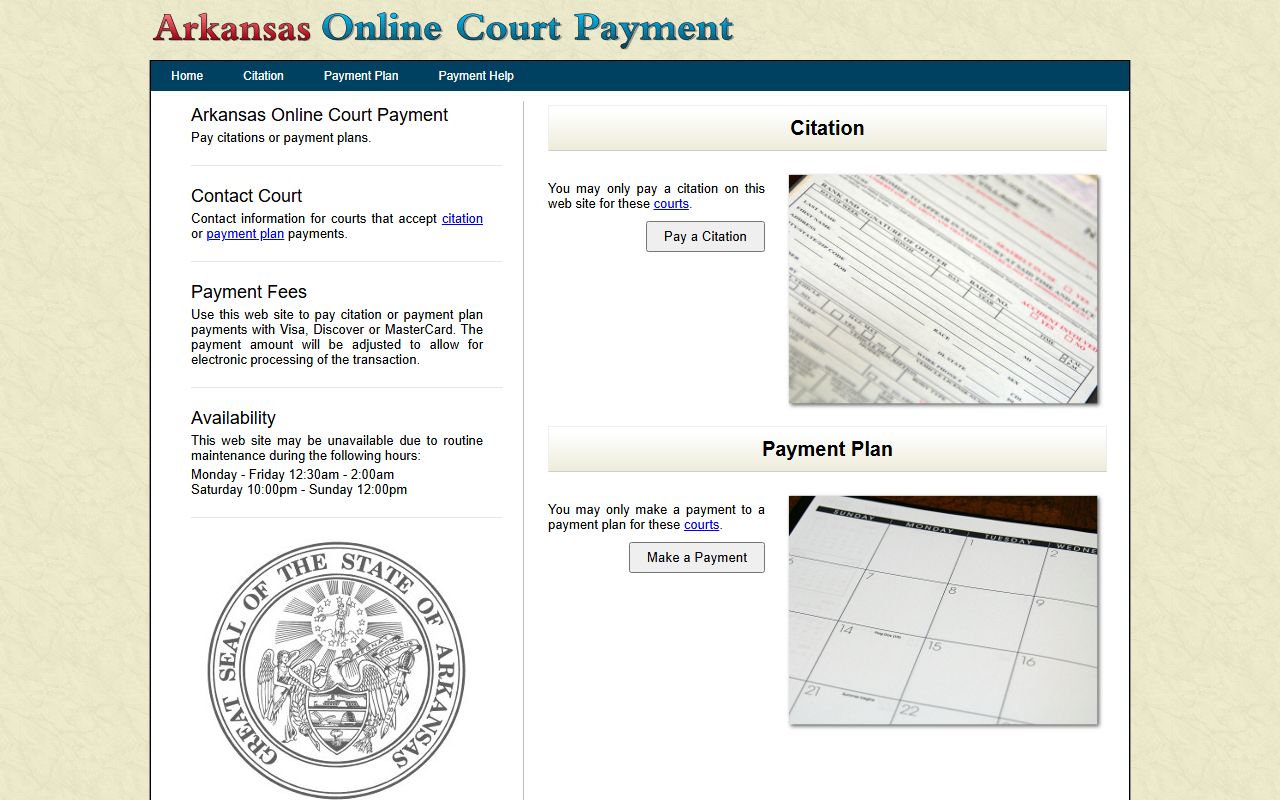
The system is offline during routine maintenance: Monday through Friday from 12:30 a.m. to 2:00 a.m., and Saturday from 10:00 p.m. through Sunday at noon.
If you miss your court date without paying or notifying the court, things get worse quickly. The court may issue a warrant for Failure to Appear. Your license can be suspended. Extra fines and costs get added to what you owe. Contact the court before your date if you have any issue showing up. Clerks can often help you reschedule.
Note: If you search for your ticket online and get an error, it may mean you are required to appear in court. Call the number on your citation to confirm your court date and status.
Types of Traffic Violations and Citation Records
Arkansas traffic violations fall into two categories: civil and criminal. Civil traffic offenses are the less serious type. They generally do not carry jail time or large fines. Criminal traffic violations are more serious. These can be misdemeanors or felonies and can lead to imprisonment along with fines. The citation itself identifies which type of offense is charged and what the applicable fine or penalty is.
Moving violations make up the bulk of traffic ticket records in Arkansas. They occur when a vehicle is in motion. Common examples include: driving with a revoked, suspended, or expired license; following too closely; leaving the scene of an accident; refusal to submit to testing; racing on a highway; passing a stopped school bus; reckless driving; failure to obey traffic control devices; and improper turning. Speeding is the single most common moving violation. The court record for a speeding ticket shows the posted speed limit, the measured speed of the vehicle, and the specific statute cited by the officer.
Non-moving violations cover things like expired registration, equipment failures, or parking issues. These are filed with the court but usually carry smaller fines. Both types become part of the public case record.
The Arkansas District Courts handle all traffic citations filed in the state. Each court follows the rules set by the Arkansas Supreme Court and operates under the supervision of the Administrative Office of the Courts.
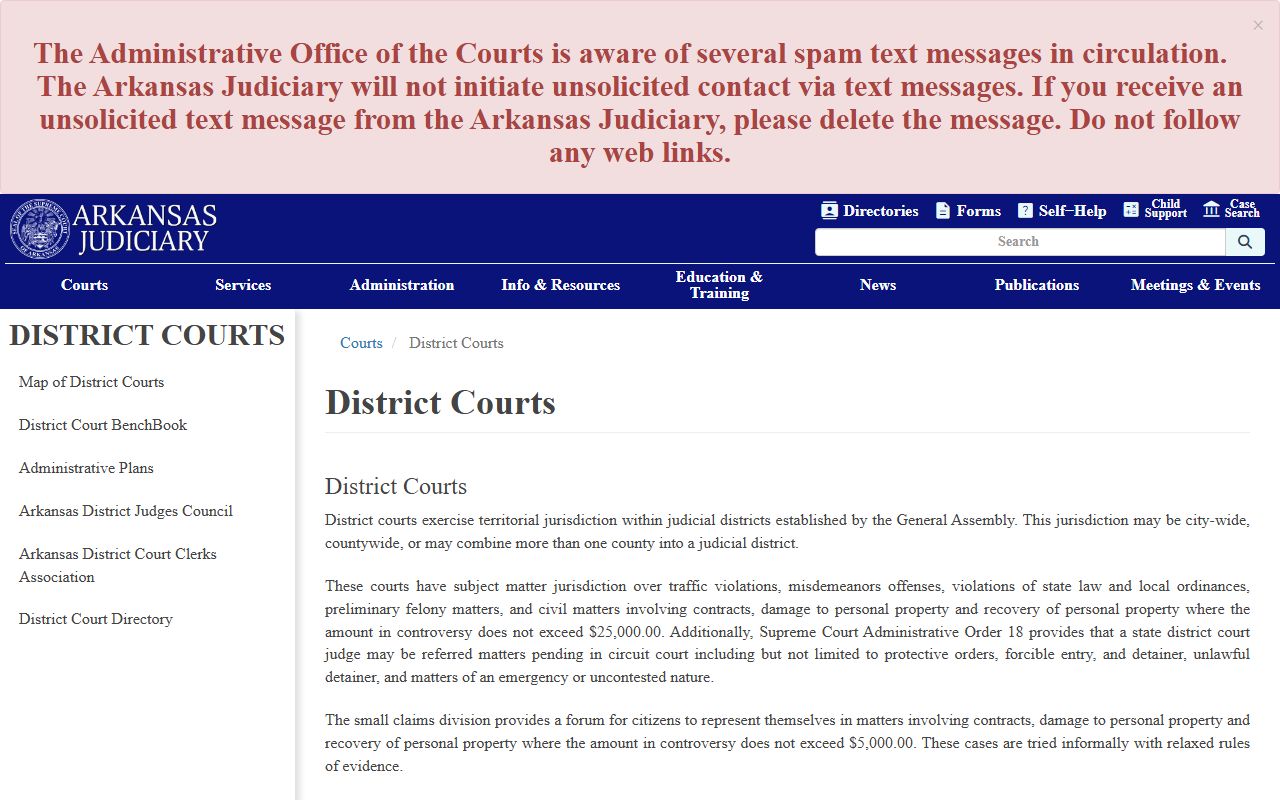
District Courts are where almost all traffic ticket cases begin and end in Arkansas. Appeals from District Court decisions go to the Circuit Court.
Traffic Violation Penalties in Arkansas
Arkansas Code § 27-50-306 lays out the additional penalties a court can impose after a conviction for a moving traffic violation. When reviewing a driver's prior traffic record, a judge may suspend the driver's license for up to one year, or grant a conditional driving permit with restrictions. The court can also require attendance at a driver's training school, order the person to retake the driver's test, or require proof of adequate vision or hearing. These additional sanctions go beyond the basic fine on the ticket.
Younger drivers face extra steps. If a person under 18 was a passenger in the vehicle at the time of reckless driving or speeding more than 20 mph over the posted limit, the court adds a five-dollar fine. That money goes to the Arkansas Children's Advocacy Center Fund. Courts may also require minors to write essays on safe driving or place them under probationary conditions.
Some courts offer traffic probation programs for first-time moving violation offenders. Pulaski County District Court's First Offender Traffic Probation Program requires no traffic tickets in the past three years, no prior probation in that court, and no DWI or DUI. The program requires attendance at defensive driving school on a Saturday at a cost of $35, a $100 monitoring fee, and a six-month period free of additional moving violations. Complete it, and the violation is dismissed and withheld from your driving record. Contact your local District Court to ask whether a similar program is available for your case.
Felony traffic offenses, like vehicular homicide or aggravated DWI, move from District Court to Circuit Court. The Arkansas Circuit Courts handle these cases and also hear appeals from District Court decisions.
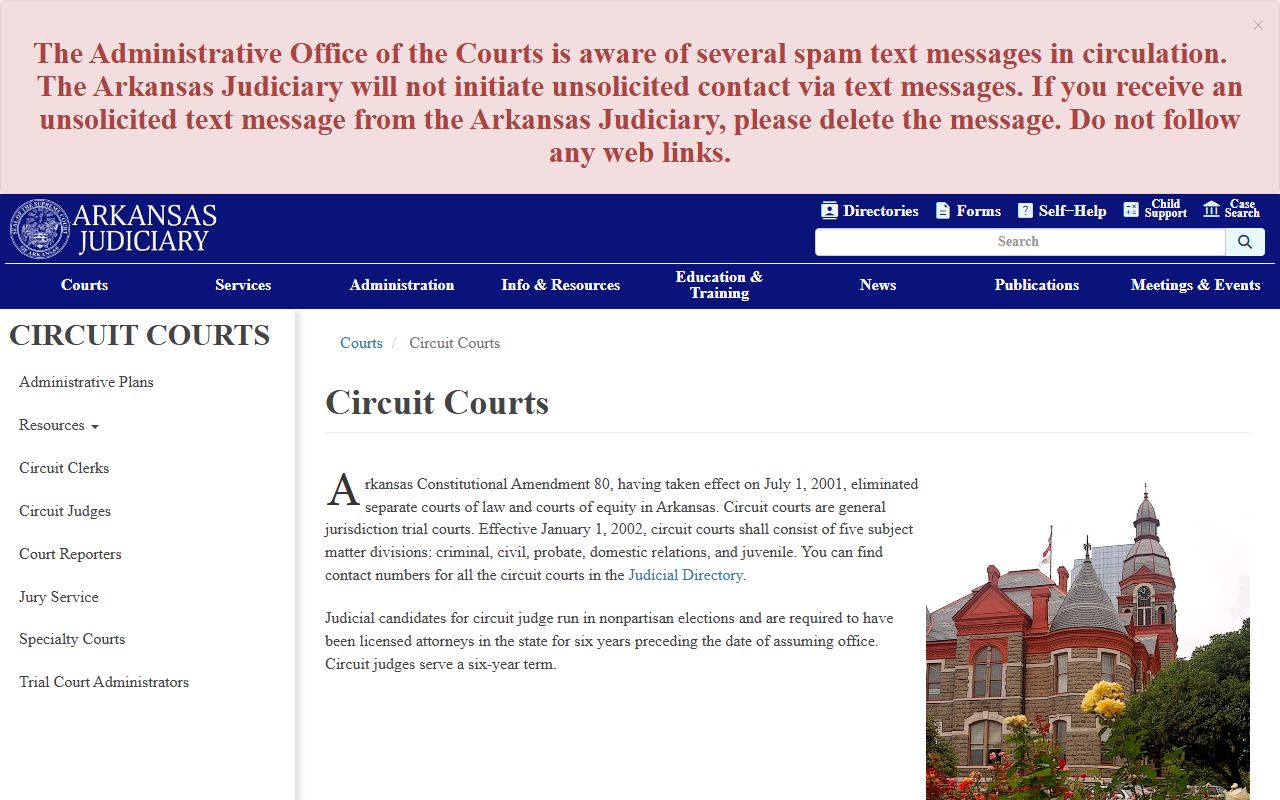
Circuit Court records for appealed traffic cases and felony traffic offenses are also searchable through the CourtConnect system for counties that participate.
Note: Defensive driving programs and probation options vary by county and court. Call your District Court clerk to find out what alternatives to fines may apply in your case.
Driving Records vs Arkansas Traffic Court Records
Traffic ticket records and driving records are related but come from different sources. A traffic ticket record is the court case file. The District Court where the citation was filed keeps it. A driving record is the state's administrative account of all violations, license actions, suspensions, and points on your license. The Arkansas Department of Finance and Administration, Office of Driver Services, maintains that record.
You can get your own driving record through the state's MyDMV service at DFA Driver Services. Records run from about $8.50 to $13 for uncertified or limited versions. Certified records and CDL records carry slightly higher fees. Under Arkansas Code § 27-50-906, access to another person's driving record is restricted. Only courts, law enforcement, employers with proper authorization, and insurance carriers for underwriting purposes are permitted to obtain it.
Civil traffic violations and criminal traffic offenses are both recorded in the court system and may also appear on your driving record maintained by the Arkansas DFA Office of Driver Services.
For the court case side, use the CourtConnect portal. For your personal driving history and license status, use the DFA MyDMV tool. They are separate systems showing different information. Both may be relevant if you are looking for a complete picture of someone's traffic history.
Public Access to Arkansas Traffic Ticket Records
Arkansas traffic ticket records are public records. They fall under the Arkansas Freedom of Information Act, enacted February 14, 1967. Section 25-19-103 says every documented record from the discharge of official duties supported by public funds is a public record. You do not need to explain why you want the records. You do not need to be a party in the case. Anyone can ask a court clerk for copies.
There are limits. Grand jury records, sealed files, and records classified under court order are not available. Arkansas Supreme Court Administrative Order 19 sets the rules on which court records cannot be posted on the internet. Records that could endanger public safety or expose victim information may also be restricted. For routine traffic ticket records, though, the case details, charge, disposition, and fine are open to the public.
The full Arkansas Motor Vehicle and Traffic Laws are published by the Arkansas Department of Transportation. That document, available at ARDOT Motor Vehicle Laws PDF, includes the complete text of relevant statutes for reference if you want to look up what law you were cited under.
The Arkansas Judiciary website is the official hub for everything related to court access in the state.
From the judiciary site you can reach CourtConnect, the e-Traffic portal, and information about all state courts from District Court level through the Arkansas Supreme Court.
Arkansas traffic court records are generated from traffic violation proceedings and include case files, evidence entries, and records related to the processing of both moving and non-moving violations through the local District Court.
To request records by mail or in person, contact the District Court clerk in the county where the ticket was issued. Bring the citation number, party name, or case number to make the search faster. Copy fees vary by court but are generally low. In-person requests can often be handled the same day.
Note: Each District Court in Arkansas handles records requests a bit differently. Call ahead to ask about fees, wait times, and whether they accept mail requests before you make the trip.
Browse Traffic Ticket Records by County
Each of Arkansas's 75 counties has its own District Court that handles traffic citations. Select a county below to find local court contact information and resources for traffic ticket records in that area.
Traffic Ticket Records in Major Arkansas Cities
Residents of major Arkansas cities have their traffic citations handled by the District Court serving their area. Select a city to find traffic ticket record resources for that location.